Research
Gathering research on the user group and analyzing the data to get insights on user needs. The steps include interviews, an observational study, competitive research, personas, and a user journey map.
User Research: Interviews
As a first step, we conducted semi-structured interviews with three different members of our user group. A semi-structured interview requires a set of interview questions to be common among all interviews to allow easy comparison between answers but allows for the flexibility to ask additional questions for elaboration and clarity. All participants happened to pet owners who work/study full time and live alone, further scoping our user group to those who fit those characteristics. The aim of the interviews was to get insight into the user’s motivations, goals, values, and pain points related to owning a pet. Asking the users directly allows us to be more confident that these are real problems pet owners face and prevent us from making assumptions about what they need.


*Pictures are of the interviewee's pet(s)
Key Takeaways
-
Goals: Keep their pet healthy and happy, establish a good relationship with their pet, and complete daily pet responsibilities efficiently
-
Pain Problems: Balancing work and social life with pet responsibilities, high cost of veterinary fees, and trouble finding accurate and trustworthy information regarding pet care
Fly-on-the-wall Observation
In order to understand more about our user group and collect more data, we also conducted a fly-on-the-wall observation at Petco to get more information on people’s behaviors when choosing products for their pet when there is a wide variety. Some assumptions about people's motivations were made based on their behaviors.
Key Takeaways
-
Some people seem to know exactly what they came for. They know the exact product and brand they need
-
Some people prefer to get really comprehensive information on a product before deciding to purchase
-
When faced with new choices, some people opt to rely on their own knowledge and judgment through reading product labels
-
People may factor in their pet’s happiness in their purchase
-
Sometimes the information on the Internet is conflicting with the store staff’s words
Competitive Research
Upon analyzing our interviews and picking out the user needs defined by our users, we conducted a competitive analysis of products and services that already exist to address those user needs. The purpose of this study is to make sure we aren’t designing for a need that is already being addressed by another product and, if the product fails to meet those needs, examine where they are lacking. The products we examined were Rover, Litter Robot, and Furbo.


Key Takeaways
-
There are a variety of products out there already attempting to serve our user’s needs
-
The user needs that existing product to fail to address are the ones that we should focus on solving or aiding
User Personas
Using the information we gained from interviews with our user group, we constructed two personas. Personas are personalities that generalize a user group’s needs, goals, and problems to summarize the important traits of the user group. The personas we created focused our design goals based on the user data. The believability and human aspect constantly reminded us to be empathetic and considerate of the user.
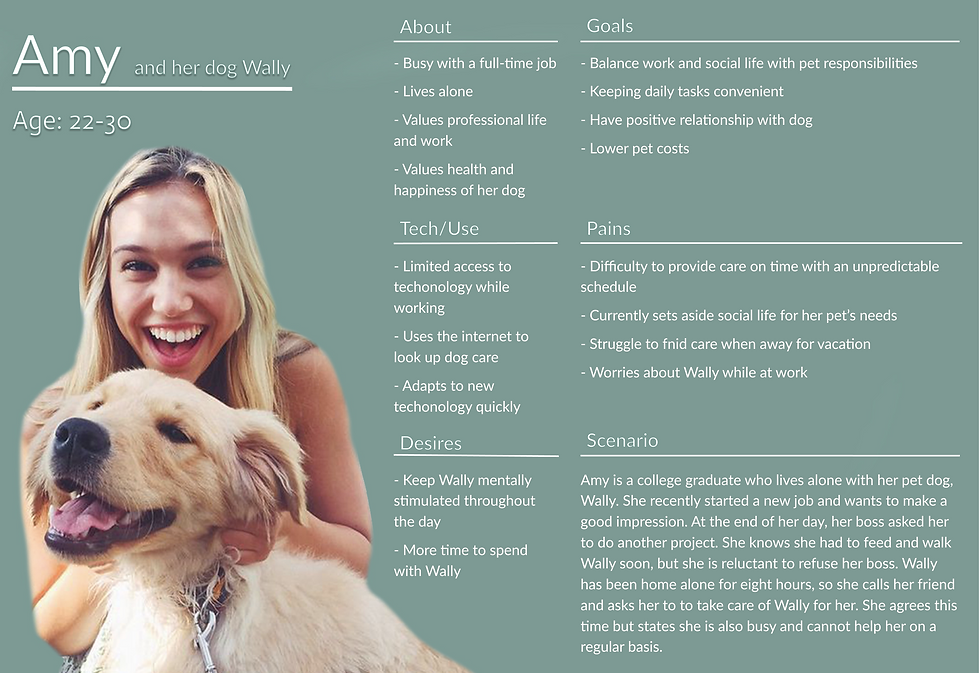

Key Takeaways
-
It’s important that personas be based on your research and avoid stereotypes or else they may not represent your users and lead you to design for the wrong problems
-
Personas are useful for quickly sharing user research with others
User Journey Map
We created a user journey map based on a scenario we created for one of the personas, Amy. We took specific event points and made a map of her level of worry and happiness depending on the events. Due to time constraints, we did not have the chance to base these levels on any real data, which would make the journey map more realistic and helpful. However, the process of thinking through each event point and what the user or persona might be feeling at the time was a good exercise in empathy and helped us to identify some pain points that the user might consider to be the most significant.

Key Takeaways
-
We realized that the most significant pain points are when our user is worried about their pets. The user is most worried when they realize they are unable to take care of their dog in order to fulfill their needs
-
The user is happiest when their dog has his needs met and when they are doing well in their jobs